Can You Monetize AI Movies on YouTube?

Creators who finish an AI-made short film or series often ask a direct question: can that work earn money on YouTube? The short answer, from YouTube's own Help Center, is that using AI tools does not by itself make a channel ineligible. You still have to meet the YouTube Partner Program (YPP) rules, follow the channel monetization policies — including the policy now named inauthentic content — and disclose realistic altered or synthetic content when YouTube requires it.
This page is a reading of official YouTube and Google Support pages, checked on 2026-11-12. It is not legal advice, and it is not a promise that any specific film will be accepted. YouTube can change these policies. When in doubt, read the official pages linked below, which always control.
What you need to join the YouTube Partner Program
YouTube's Help article YouTube Partner Program overview & eligibility lists what a channel needs before it can apply. As of 12 November 2026, that list includes: following the YouTube channel monetization policies; living in a country or region where YPP is available; having no active Community Guidelines strikes; turning on 2-Step Verification; having advanced features access; and having, or being ready to set up, an AdSense for YouTube account linked to the channel.
Once those conditions are understood, the same article says a channel can become eligible with either long-form video or Shorts:
- 1,000 subscribers and 4,000 qualified watch hours in the last 12 months, or
- 1,000 subscribers and 10 million qualified Shorts views in the last 90 days.
Qualified watch hours from Shorts views in the Shorts Feed do not count toward the 4,000-hour long-form threshold. Private, unlisted or deleted videos, ad campaigns, YouTube Shorts, and livestreams that are unlisted, deleted, or not converted to VOD do not count as qualified watch hours. Meeting the numbers also does not admit you automatically. YouTube says every channel that meets the threshold goes through a review to check whether it meets the monetization policies.
A change already announced for 1 February 2027
The same eligibility article, and YouTube's Changes to the YouTube Partner Program page, already describe an update that starts on 1 February 2027. For new creators, the YPP entry thresholds become 8,000 qualified watch hours in the last 365 days, or 20 million qualified Shorts views in the last 90 days, still with 1,000 subscribers. YouTube states that if you are already in YPP, your status is not impacted by this update.
The changes page also says that to continue fully monetizing, creators should review and accept the updated terms in YouTube Studio by 31 January 2027. If the updated terms are not accepted by that date, YouTube says you will stop earning from the associated monetization features beginning 1 February 2027, and that this decision does not, by itself, remove the channel from YPP. Fan funding, YouTube Creator Partnerships and YouTube Shopping are described there as unchanged in their earlier entry path: 500 subscribers and either 3,000 qualified watch hours in the last year or 3 million qualified Shorts views in the last 90 days.
Inauthentic content, formerly repetitious content
The YouTube channel monetization policies say that if you are making money on YouTube, your content should be original and "authentic." YouTube's stated expectation is that the work is your original creation — or, if you borrow content, that you change it significantly to make it your own — and that it is not mass-produced, generic, repetitive, or manipulative. It should be made for the enjoyment or education of viewers, rather than for the sole purpose of getting views.
A 15 July 2025 update on that page renamed the long-standing "repetitious content" policy to "inauthentic content," and clarified that it includes content that is repetitive or mass-produced. YouTube says this type of content has always been ineligible for monetization under the existing policies, and that the reused-content policy — which reviews commentary, clips, compilations and reaction videos — is unchanged.
The same policy is not a ban on series, or on a channel that follows a recognizable pattern. YouTube's examples of what is allowed to monetize include a series that follows a set of characters across episodes, provided each video has a distinct storyline, focus or concept, and a channel that uses the same intro and outro if the bulk of each video is different. What is not allowed, in YouTube's own examples, includes similar or repetitive videos with low educational value, commentary, narratives, or minimal variation; videos that put characters in the same situation over and over again with the same outcome; image slideshows, templated storylines, or scrolling text with minimal or no narrative, commentary, or educational value; and "AI-generated content made with generic or unoriginal templates giving the impression of mass production without adding the creator's original, authentic insights or perspective."
In a July 2025 response to creator questions on the YouTube Help Community, YouTube staff wrote that the update was a clarification of an existing guideline, that the guidelines apply regardless of how the content was made, and that "We welcome creators using AI tools to enhance their storytelling, and channels that use AI in their content remain eligible to monetize." The same post says all channels must still follow the monetization policies, and that creators are required to disclose when their realistic content is altered or synthetic.
Disclosing altered or synthetic content
YouTube's Help article Disclosing use of GenAI content requires creators to disclose AI-generated or altered content that seems realistic. The disclosure is made during upload, in YouTube Studio, under the "AI use" setting.
Creators must disclose GenAI content that: makes a real person appear to say or do something they did not do; alters footage of a real event or place; generates a realistic scene that did not actually occur; or creates music that is the main focus of the video. This can include content that is fully or partially altered or created using AI tools. YouTube's examples of what needs disclosure include AI-generated music, realistic extra footage of a real place, and a realistic depiction of a weather event moving toward a real city that did not happen.
Creators do not need to disclose non-realistic content made with AI, or minor edits to realistic content. YouTube describes minor edits as ones that are primarily aesthetic and do not alter the content in a way that could mislead the viewer about what actually happened. Official examples of what you do not need to disclose include clearly unrealistic work, such as someone riding a unicorn through a fantastical world or a fully animated video; beauty, color, lighting or special-effects filters; production assistance such as using generative AI to create or improve a video outline, script, thumbnail, title or infographic; idea generation; caption creation; and cloning one's own voice for voice-overs or dubs.
The same article states: "Disclosing AI content alone won't limit a video's audience or impact its eligibility to earn money." It also warns that creators who consistently choose not to disclose this information may be subject to a label applied by YouTube, or to penalties including removal of content or suspension from the YouTube Partner Program. Community Guidelines still apply to AI-generated or AI-altered content.
What this means if you make the film in TikFilmer
TikFilmer is an AI film maker for a story you write or paste, not a factory for interchangeable clips. You start from a script or a one-line idea, keep characters and locations in a reusable library, and plan shots as dramatic units with a shot list before the frames. A successful timeline export is an MP4. The clips can also be downloaded as a ZIP, and the timeline can be exported as a Premiere or Final Cut XML project. A failed render is not a finished MP4. That workflow can support original stories, including a story turned into one film or a novel or book turned into a series of episodes. YouTube's own allowed example of a series with a distinct storyline in each episode is the closest official match for that kind of work — provided each episode actually has a distinct story, and is not the same situation with the same outcome.
Two limits still sit with you, not with the software. First, original and authentic, in YouTube's terms, is about the finished channel, not about whether a tool was used. A run of barely varied shorts from a generic template is the kind of work YouTube lists as ineligible, even if each file was generated in a serious tool. Second, if a scene is realistic — a real person, a real place, or a realistic event that did not happen — you must disclose it in YouTube Studio. A clearly fantastical or animated short may not need that disclosure, under the official examples. When you are unsure, disclose and read the official article.
TikFilmer's own FAQ says you own the movies you export, including for commercial use, on Free and on paid plans. That is a statement about the files you take out of the product. It is not a decision by YouTube, and it is not a substitute for copyright in the story you adapt. If the book or the script is not yours, you need the rights to it. YouTube's reused-content and copyright rules are separate from the inauthentic-content policy, and this page does not restate them beyond pointing you to the official monetization policies.
Content that monetizes with ads must also follow YouTube's advertiser-friendly content guidelines. A film can be original and still be limited, or ineligible for ads, if it is not advertiser-friendly. Read that page for the categories YouTube lists.
Official sources, checked 12 November 2026
- YouTube Partner Program overview & eligibility
- Changes to the YouTube Partner Program
- YouTube channel monetization policies (including the inauthentic content policy, renamed from repetitious content on 15 July 2025)
- Disclosing use of GenAI content
- Response to creator questions about YPP policies (July 2025)
- Advertiser-friendly content guidelines
If any of these pages has been updated since 12 November 2026, follow the live official text. This article will not invent thresholds, exceptions or penalties that those pages do not state.
FAQ
Does YouTube ban AI-made movies from monetization?
No official page reviewed for this article says that using AI tools makes a channel ineligible. In a July 2025 Help Community response, YouTube staff wrote that channels that use AI in their content remain eligible to monetize, and that all channels must still follow the monetization policies, including disclosure when realistic content is altered or synthetic.
If I meet the subscriber and watch-hour numbers, am I in YPP?
No. YouTube's Partner Program eligibility article says every channel that meets the threshold goes through a standard review to check whether it meets the monetization policies and guidelines. You also need the other listed requirements, including no active Community Guidelines strikes and an AdSense for YouTube account.
Do I have to disclose every AI film I upload?
YouTube requires disclosure for AI-generated or altered content that seems realistic, including a realistic scene that did not actually occur. You do not need to disclose non-realistic content made with AI, or minor aesthetic edits. Disclosing AI content, YouTube says, will not by itself limit the audience or affect eligibility to earn money. Consistent failure to disclose can lead to a label, removal of content, or suspension from YPP.
Can a series of AI episodes be monetized, or is that repetitive content?
YouTube's inauthentic content policy, in the official examples, allows a series that follows a set of characters across episodes when each video has a distinct storyline, focus or concept. It does not allow videos that put characters in the same situation over and over with the same outcome, or AI-generated content made with generic or unoriginal templates that give the impression of mass production without the creator's original, authentic insights or perspective.
When do the YPP thresholds change?
As of 12 November 2026, the public eligibility thresholds are still 1,000 subscribers plus 4,000 qualified watch hours in 12 months, or 10 million qualified Shorts views in 90 days. YouTube has announced that starting 1 February 2027, entry thresholds for new creators become 8,000 qualified watch hours in the last 365 days, or 20 million qualified Shorts views in the last 90 days, still with 1,000 subscribers. Already-in YPP status is described as not impacted by that update. Accept the updated terms in YouTube Studio by 31 January 2027 to continue fully monetizing.
If I export a film from TikFilmer, is it cleared for YouTube monetization?
No. TikFilmer says you own the movies you export, including for commercial use, but that is not a YouTube decision. You still have to meet YPP rules, follow YouTube policies, disclose realistic synthetic content when required, and hold the rights to the story you adapt.
If you are still planning the film itself, start with how to make an AI movie or story to movie. New accounts on TikFilmer start with 350 free credits, issued once.
More articles
View all articles →
Make a Movie with AI
A first film with AI: start from a story or one sentence, keep the cast from drifting, give neighboring scenes different pacing, then reach a rough cut with Autopilot or Cards and Canvas.
Turn a Family Story Into a Movie With AI
A birthday, an anniversary, or a short memoir: paste the words, plan the beats, then take a first cut with Autopilot or repair one beat in Cards and Canvas.
A Cinematic AI Film Workflow
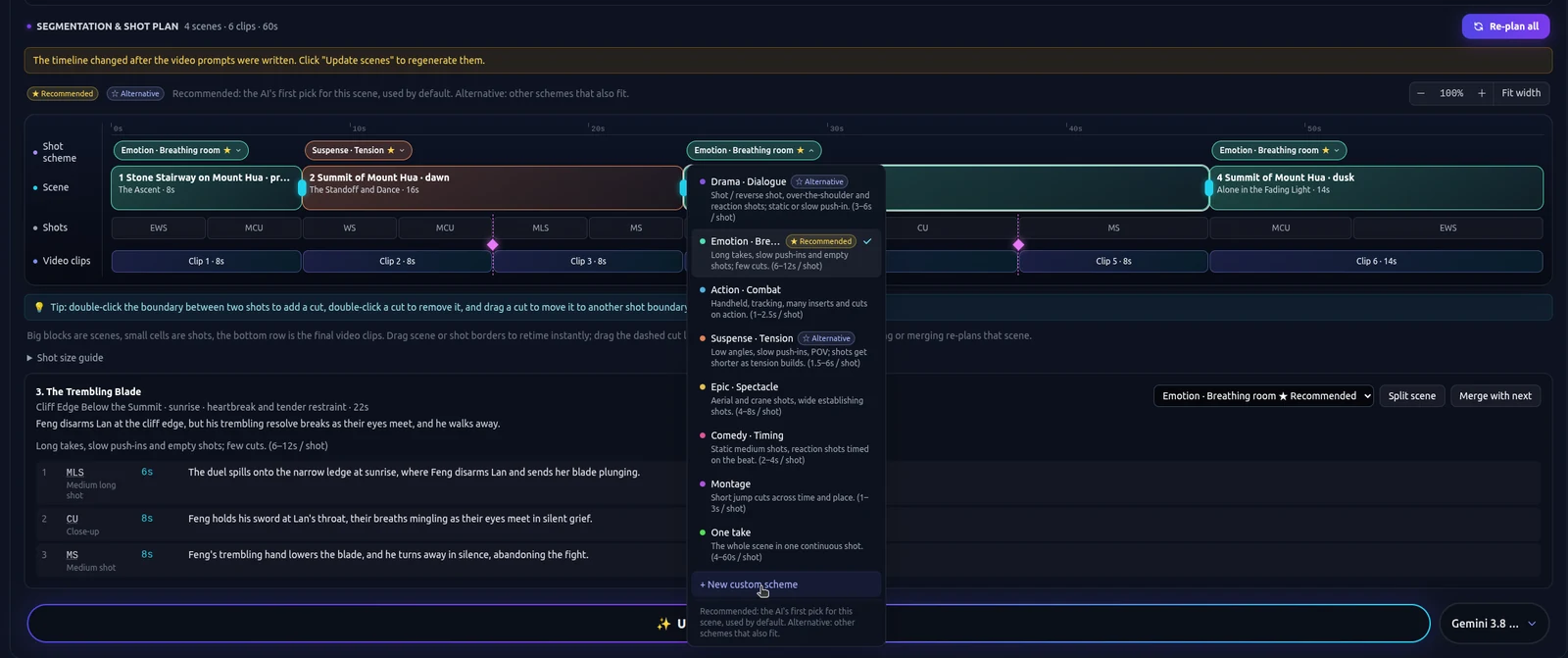
Rhythm for an AI short: story beats, coverage, and a different shot plan for a tense segment than for one that should hold. The beginner how-to is a separate page.
How to Make an AI Movie
The order of work for an AI movie: a story you paste or draft, assets, a shot plan, clips and a rough cut, plus when Autopilot or Cards and Canvas is the better way through it.